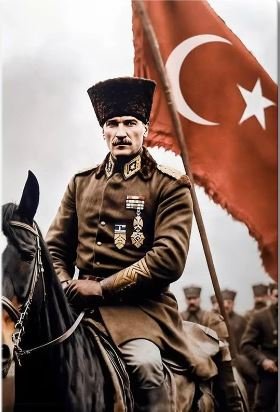
MEMORIES FROM ATATURK
MEMORIES 1
1-Welcome Halil Agha
2-You Resemble Napoleon
3-Ataturk And Sister Gülsüm
4-Don't involve them in this
5-Ataturk's Dream
7-I Want to Learn From You (ANZAC)
8-Without a Single Bullet Being Fired!..
10-Genius of the 20th Century.
11-What Was His Father Doing in Dardanelle.
12-The soil of my country is clean.
13-I Couldn't Teach Them To Be Servant
15-A Village Woman And Atatürk.
16-Did You Have an Order, Pasha?
17-Since the Order Came From Him.
18-Why Didn't He Keep His Promise?
20-I was wrong one day in my calculations.
21-Remove This.
Title 7
Title
8
Title 9
Title 10
Title 11
Title 12
Title 12
Title 13
Title 14
Title 15
Title 16
Title
17
Title 18
Title 19
Title 20
ANILAR 2
Title 1
Title 2
Title
3
Title 4
Title 5
Title
6
Title 7
Title
8
Title 9
Title 10
ANILAR 3
Title 1
Title 2
Title
3
Title 4
Title 5
Title
6
Title 7
Title
8
Title 9
Title 10
SECTION 4
Title 1
Title 2
Title 3
Title 4
Title 5
Title 6
Commander-in-Chief Mustafa Kemal Pasha launched the Great Offensive from Kocatepe at 5:30 a.m. on August 26, 1922, with cannon fire, personally commanding the battle. The enemy was routed in the field battle of Dumlupınar on August 30 and in hand-to-hand combat, and victory was achieved with the Turkish Army's entry into Izmir on September 9, 1922. On the 103rd anniversary of this victory, we commemorate all our martyrs and veterans, especially Ghazi Mustafa Kemal Atatürk and his comrades-in-arms, with mercy and gratitude. (August 26, 2025)
THEN GO TO GREECE
Mr. Salih Bozok recounts another memory of Atatürk as follows: The day
before the Great Izmir Fire, I entered the Governor's office at the
Government House to present information to Mustafa Kemal Pasha. Inside were
Mustafa Kemal, the Governor, and the British Consul.
Mustafa Kemal Pasha harshly addressed the British Consul:
-Do you want assurances from
me regarding your citizens? Were your citizens (nationals) safer when the
Greeks were here?
When the British Consul replied:
-Yes,
Mustafa Kemal Pasha became even more stern and loudly declared:
-In that case, go to Greece!
The British Consul, faced with this outburst, asked:
-Are you declaring war on England too?
In response to the British Consul's overstepping of bounds, Atatürk spoke,
as if slapping him:
-Has peace been made between
us and England? You're asking whether I've declared war. And are you
authorized to discuss such things, that you're asking me this?" I am the
Speaker of the Grand National Assembly of Turkey and the Commander-in-Chief
of the Turkish Armies. I have the authority to discuss everything. If you
have such authority, then only then can we discuss it with you. If you don't
have such authority, then go ahead.
As Mustafa Kemal Pasha said, "Go ahead," he was showing the
British Consul the door. The British and French navies were at the port.
A crowd of Greeks, driven from the areas cleared of the enemy, had turned
the dock into a place of devastation.
Shortly after the British Consul left the Government House, we arrived at
our residence. Meanwhile, preparations began in the port fleet. All hell
broke loose in Izmir. Boats from the ships would come to the shore, pick up
any foreign nationals on the docks, and take them to the ships.
The consul told the commander of his fleet that the Turks had also declared
war on the British. The situation was extremely serious. While the boats
were picking up the foreigners on the docks and carrying them to the ships,
the fleet commander sent several of his officers to Mustafa Kemal Pasha,
requesting information about the situation.
I don't know exactly what was said. But Mustafa Kemal Pasha must have
explained the situation, because the truth was understood, and the
atmosphere of panic and anxiety returned to normal. One of the officers sent
from the fleet to meet with Mustafa Kemal Pasha had such great affection and
respect for him that I heard him ask permission to kiss his hand.
After the Izmir fire, we moved into Muammer Bey's house. We stayed there for
three weeks. During this time, all of us, from Mustafa Kemal Pasha to our
servants, experienced Latife Hanım's exceptionally warm and kind attention.
After arriving in Ankara from Izmir, Mustafa Kemal Pasha would speak of
Latife Hanım almost every evening at the dinner table, praising her.