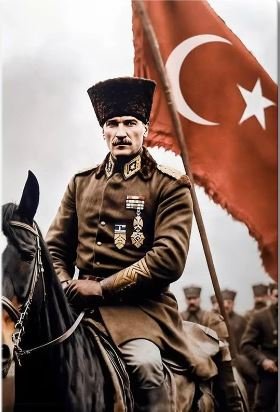
MEMORIES FROM ATATURK
MEMORIES 1
1-Welcome Halil Agha
2-You Resemble Napoleon
3-Ataturk And Sister Gülsüm
4-Don't involve them in this
5-Ataturk's Dream
7-I Want to Learn From You (ANZAC)
8-Without a Single Bullet Being Fired!..
10-Genius of the 20th Century.
11-What Was His Father Doing in Dardanelle.
12-The soil of my country is clean.
13-I Couldn't Teach Them To Be Servant
15-A Village Woman And Atatürk.
16-Did You Have an Order, Pasha?
17-Since the Order Came From Him.
18-Why Didn't He Keep His Promise?
20-I was wrong one day in my calculations.
21-Remove This.
Title 7
Title
8
Title 9
Title 10
Title 11
Title 12
Title 12
Title 13
Title 14
Title 15
Title 16
Title
17
Title 18
Title 19
Title 20
ANILAR 2
Title 1
Title 2
Title
3
Title 4
Title 5
Title
6
Title 7
Title
8
Title 9
Title 10
ANILAR 3
Title 1
Title 2
Title
3
Title 4
Title 5
Title
6
Title 7
Title
8
Title 9
Title 10
SECTION 4
Title 1
Title 2
Title 3
Title 4
Title 5
Title 6
Commander-in-Chief Mustafa Kemal Pasha launched the Great Offensive from Kocatepe at 5:30 a.m. on August 26, 1922, with cannon fire, personally commanding the battle. The enemy was routed in the field battle of Dumlupınar on August 30 and in hand-to-hand combat, and victory was achieved with the Turkish Army's entry into Izmir on September 9, 1922. On the 103rd anniversary of this victory, we commemorate all our martyrs and veterans, especially Ghazi Mustafa Kemal Atatürk and his comrades-in-arms, with mercy and gratitude. (August 26, 2025)
Ms. Ayten Kuttas, listening to the memoir of a retired soldier who
participated in the War of Independence, summarizes it as follows:
...We were fighting on the Western Front. The defeated Greeks had begun to
surrender. Our Battalion was assigned to the village of Aslanlar. Despite
being very close to the enemy, and lacking sufficient weapons, ammunition,
and vehicles for our defense, we nevertheless captured the enemy column,
turning and controlling the mail coaches. One day, we also intercepted an
order in one of the mail documents announcing the appointment of General
Trikupis to the rank of Major General.
We captured the column under Trikupis's command and reported the situation
to the Commander-in-Chief. Upon receiving the order, we set out to take
Trikupis to Dumlupınar...
I am sharing a summary of the surrender from the diary of Trikupis,
Commander-in-Chief of the Greek Armies: He recounts:
.... Upon receiving news that Uşak had been retaken by the Turks, I was
no longer in a position to do anything. The best course of action would be
to hide and rest the soldiers until dark.
I took security precautions and ordered the men to remain in their
trenches. We were a little east of Uşak. Around 4:00 PM, the guards to the
south reported seeing Turkish cavalry approximately one kilometer away and
Turkish infantry four kilometers away.
My soldiers, whom I had intended to send to the first line, replied that
they did not want to die in vain, as they lacked ammunition.
One of the trumpets, without anyone's order or knowledge, blew the
cease-fire horn.
The soldiers in the first line fired a few shots at the enemy, who were a
short distance ahead of them, a bullet's throw away, and then abandoned
their positions. I ran to the trumpet and shouted, "Commence fire...".
My order was carried out.
I intervened among the soldiers, weary of going to the firing line. I tried
to persuade them by talking about home, honor, and dignity.
But I couldn't get them to listen.
I saw with alarm that the order I had given to the divisional artillery to
open fire had not been carried out.
Minutes passed, and the artillery fire would not begin. The news that
arrived a short time later was tragic: the armed infantry had surrounded the
artillery and prevented them from opening fire. Rather than engage in
another battle with the Turks, surrender was the safest option.
I advised the units that before making any decisions, an official report,
signed by their commanders, should be submitted to persuade the soldiers to
rejoin the battle line. Indeed, the unit commanders did report this way, and
the Chief of Staff of the I Corps stated that no one wanted to fight and
that the soldiers were threatening the officers with any losses. I then
tried to persuade the soldiers to rejoin the battle line. However, all the
officers present informed me that they had given up fighting, and they
argued that fighting was essentially futile, and that if I persisted,
resistance would be more effective and likely lead to the surrender of the
entire officer corps to the enemy. So, with a wounded heart, faced with this
painful situation, I ordered the firing of the cannons and machine guns and
agreed to the raising of the white flag atop the 1155-meter-high hill...
Let's follow a summary from the writings of our renowned writer Halide
Edip Adıvar, who witnessed the encounter between Trikupis and Gazi
Mustafa Kemal Pasha.
...We were heading to Uşak. We were stopping
passersby and asking questions. The murders were heinous. Nearly a hundred
of our citizens had been killed or burned. Some of them were women. The
people were completely stunned by this brutality.
After Kızlcadere, the Greeks had lost all hope and began to destroy
everything.
We stayed in Uşak for three days. At headquarters, everyone was talking
about Trikupis. The previous Commander-in-Chief, Hacı Anesti, had been
dismissed from his post. The Greeks didn't know where General Trikupis was.
Some said he had committed suicide.
On the second of September, we found Mustafa Kemal Pasha, Fevzi Pasha, and
İsmet Pasha sitting around a table in Uşak. General Trikupis and General
Dionis had surrendered to the Turks. They came before Gazi Mustafa Kemal
Pasha between Nureddin Pasha and Kemaleddin Pasha. If they hadn't been
protected, the people of Uşak would have torn them apart. The people of Uşak
considered them among those who had killed their loved ones and destroyed
their homes and property, paying no attention to their ranks or status.
When they brought in the Greek Generals, Mustafa Kemal Pasha stood between
Fevzi Pasha and İsmet Pasha. For me, this was a military drama of the first
order. Therefore, I watched and listened with great interest.
Our soldiers' uniforms were as plain as the soldiers', their faces calm and
motionless. In contrast, the Greeks wore gold-embroidered uniforms. Their
faces and hands revealed a deep nervousness. Fevzi Pasha was as calm as a
Buddha statue. İsmet Pasha tried not to show the anger in his eyes. He could
not tolerate the cruelty inflicted on the local people.
Fevzi Pasha and İsmet Pasha bowed slightly, but did not offer their hands.
Mustafa Kemal Pasha was the dominant character in this scene. This soldier,
who crushed his political opponents without a second thought, was a great
artist in the military and an athlete who adhered to the rules of the game.
He seemed indifferent to the appearances of the Greek Generals and the
misdeeds of their entourage. Trikupis was his opponent in this game. In this
military game, he maintained the proper demeanor to the man he had knocked
to the ground, and like a victorious wrestler shaking the hand of a wrestler
whose back he had brought down, he held Trikupis's hand for longer than a
simple handshake. Standing, he welcomed his defeated and captive enemy:
-Sit down, General. You must
be tired..." he said.
He held out his cigarette case and ordered coffee.
Let's continue the summary of the incident from Trikupis's memoirs:
...I was taken prisoner near Uşak. First, I was taken to the headquarters
of İsmet Pasha, Commander of the Turkish Army. He took me to
Commander-in-Chief Mustafa Kemal without making me wait. When I entered
Mustafa Kemal's office, he greeted me standing and friendly. He said the
following in relaxed French:
-Remember that the great
Napoleon was also a hostage. You fulfilled your duty
completely and completely. We, too, appreciate and respect you. You are not
our hostage here, but our guests."
He paused for a moment. His steely eyes scanned me, and he asked:
-Do you know you have been
appointed Commander of the Asia Minor Armies?
I was surprised. I paused for a moment.
-No!" I answered his question.
Mustafa Kemal Pasha turned to İsmet Pasha and said:
-I think commanders need
rest.
As Trikupis was about to leave, he requested that his family in Istanbul be
informed of his health."
Gazi Pasha instructed that the address be obtained and delivered through the
Red Crescent, and he did not forget to issue Trikoupis the order announcing
his promotion to Major General. The following news item appeared in Athens
newspapers on August 23, 1922:
Brigadier General Trikoupis, who was at the front, was appointed Commander
of the Asia Minor Armies. For his bravery on the battlefield, he was also
promoted to Major General…
---------------------------------------------------------------------------------------
After Atatürk's passing, Greek General Trikopis observed a moment of silence every year on October 29th (the date of the declaration of the Turkish republic) in front of the Atatürk bust at the Turkish Embassy in Thessaloniki ( Atatürk birth place) until her death.
--------------------------------------------------------------------------------------
...While retreating towards Izmir, General Trikupis,
Commander of the Greek 1st Corps, and General Digenis, Commander of the 2nd
Corps, were captured at Çalköy near Murat Mountain on September 2nd, along
with their high-ranking staff and soldiers. Trikupis and Digenis were
delivered to the Turkish headquarters in Uşak and were first brought to
İsmet Pasha. İsmet İnönü, who recounts this encounter in detail in his
memoirs, begins his conversation with General Trikupis about the battle with
the following question:
İsmet Pasha:
-Why did you cease artillery fire so quickly on the
first day of the battle? We were pounding your front, and you weren't
responding. Yet, you hadn't yet decided to withdraw. Your infantry was
holding firm.
General Trikupis:
-The observation points for the batteries were chosen far forward. The
observation points and batteries were connected by cables. Your artillery
fire began so intensely and consistently that all the observation posts we
had moved forward so we could use our own artillery more accurately fell and
were destroyed. The cannons remained, still containing ammunition. Some of
the officers and men at the observation posts were killed, and the telephone
cables were severed, leaving us unable to fire.
İsmet Pasha:
-We were attacking Akşehir from a flank position.
Why didn't you launch an attack towards Akşehir?
General Trikupis:
-Your cavalry fell behind us, and we panicked.
İsmet Pasha:
-Why didn't you help the situation
on the front line?
General Digenis:
-How was I supposed to help? I was also attacked. All my positions fell.
Besides, my orders were to defend them. Therefore, I reinforced my front
with the forces under my command and counterattacked, repelling your forces
and recapturing the positions.
Ismet Pasha:
-Why didn't you retreat to Eskişehir?
Trikupis:
-I received orders to retreat towards Izmir and block the Izmir route.
Commander-in-Chief Hacianestis, in accordance with his orders, withdrew his
troops towards Izmir upon realizing we were losing the battle on the front.
After the speeches, Ismet Pasha donned his bandolier and sword.
-I will present you to the Commander-in-Chief with
my official duties, he said, and took Trikupis and Digenis to Mustafa Kemal
Pasha's headquarters.